
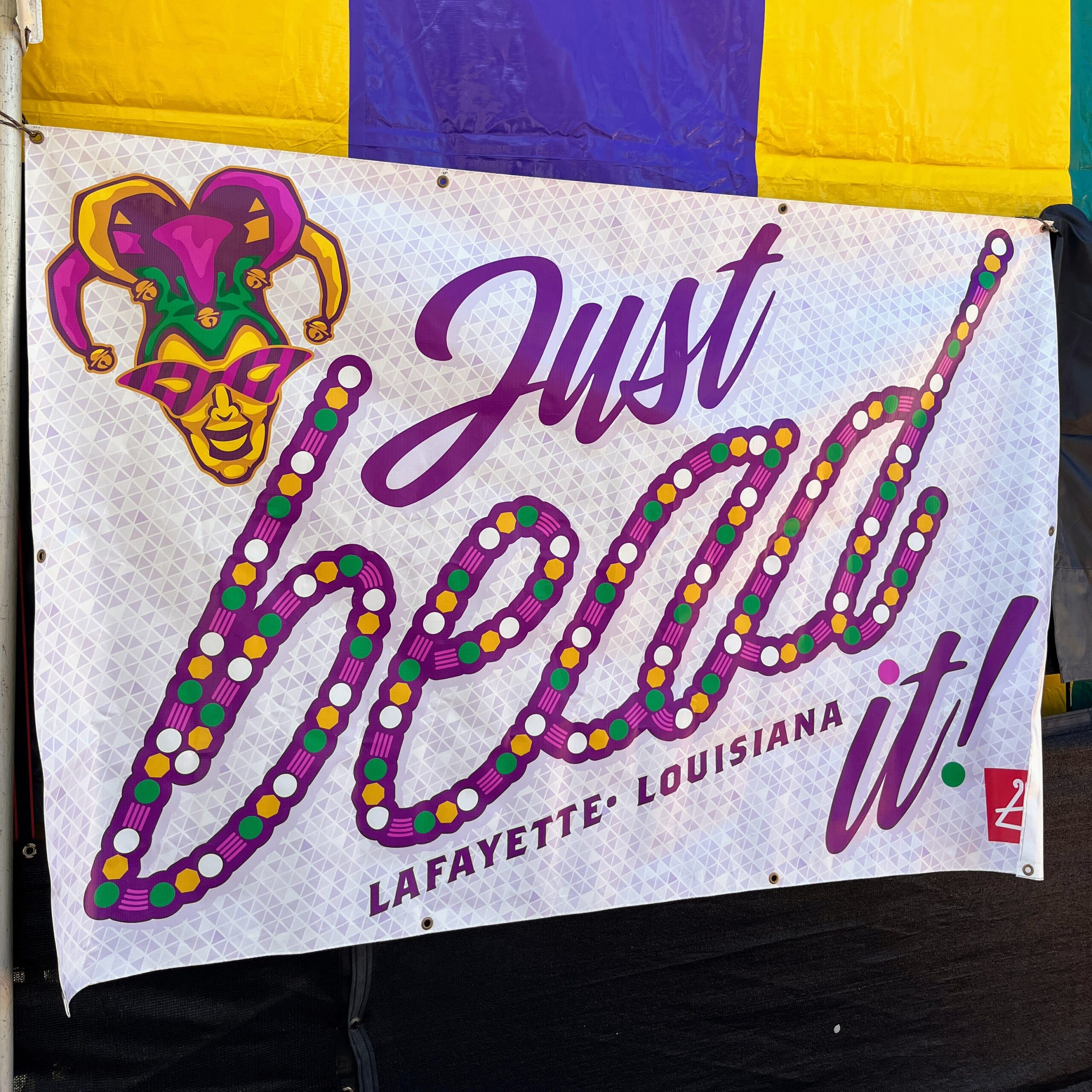
This trip had been knocking around the back of my mind for a while. And for me, that’s a big piece of retirement travel — finally getting on with the travel I’ve thought about but never found the time to do. LIke this road trip to experience Mardi Gras in Mobile, New Orleans, and Cajun Country.

My high school geography class should’ve prepared me for how flat everything is along the Gulf Coast, but it didn’t. On Thursday morning, driving from New Orleans to Lafayette along US 90, the land was flat and the sky was big. And driving the roads outside of Lafayette, I was struck by how much it reminded me of the rural Midwest — places like downstate Illinois and Indiana where, once you get off the interstates, you find long stretches of flat fields punctuated by stands of farm trees and the occasional small town. The accent is different but the landscape, when you’ve pushed up from the coastal bayous, is a lot the same.
Driving through towns on US 90 rather than around them on I-10, it was clear how important the off-shore oil business is here. I didn’t see any of the big oil names like Exxon or Chevron. Instead, it was their smaller suppliers — supply yards stacked with lengths of metal tubing, shops doing pump repairs, dockyards along the rivers that the US 90 bridges arch high over.
Tabasco Detour
A little over two hours into our drive, we took a quick detour to Avery Island to tour the Tabasco plant. It was nice — a quiet campus of buildings. We did the self-guided tour; we hadn’t planned far enough ahead for the guided tour. The standout was the barrel house, a rickhouse of pepper mash-filled barrels covered in salt. There was a definite pepper “tang” in the air.

But if I read the placards correctly, most of their pepper growing and mashing now takes place at contract farms in Latin America and Africa. Compared to other small plant tours I’ve taken — whiskey distilleries, the Louisville Slugger factory — this one was more about displays explaining the sauce than showing it being made, save for the last buildings where mixing vats and bottling lines sat behind plexiglass. I wanted to see a bit more action. Maybe we would’ve gotten more out of the guided tour. The tasting bar at the Tabasco store, though, was worth the stop. We came away with a couple of bottles that we hadn’t seen in grocery stores back home.
Walking Around Lafayette
Lafayette is a nice town. It has a walkable city center core with the requisite upscale coffee joints and small sundry shops. We walked past Pop’s Poboys, looked back at the menu through the window, turned around, and walked in. We might have found a more “authentic” po-boy place, but Pop’s had an interesting menu — the classics plus some new twists — and it was there and we were hungry. It was a solid choice.

Lafayette leans hard into its Cajun heritage; its role as the main city of Acadiana. About 2½ miles from downtown, along Bayou Vermilion, is Vermilionville Historic Village. It’s an outdoor “living history” museum with restored houses, costumed interpreters doing craft demonstrations, recreating what daily life looked like in this corner of Louisiana between the 1790’s and the 1880’s. It wasn’t crowded; we could take our time.
Walking through one of the houses, I was surprised to find an interpreter sitting quietly in the front room doing some quilting. We talked for about 10 minutes about Vermillionville, what brought her there (marriage to a local; she’s originally from Pennsylvania), and her quilting. I’m usually not one for Williamsburg-style reenactments, but I surprised myself by liking Vermillionville. Maybe because it was much more low-key than other “living history” places I’ve visited.
More Parade Strategy
We stayed in a bed-and-breakfast about a 5-minute walk from downtown — a big house and a collection of outbuildings that had originally been part of a plantation. Nice-sized room, solid breakfast, but most importantly, it was very conveniently located for parade watching — maybe 2½ blocks from the parade route and right near the start.
That lined up with the parade strategy — don’t get stuck in the middle of the route. Position yourself either at the start (as we did in Mobile and Fairhope) or right at the end (as we did in New Orleans). The start gets you out before traffic locks up; works best when it’s just one parade. The end works better when there are multiple krewes stepping off — when there’s a parade of parades.

We caught two parades in Lafayette — the kick-off on Friday night and the Krewe of Bonaparte on Saturday night. Bonaparte was definitely the better parade — longer, more interesting floats, more interesting throws. It was also our last parade of the trip, so we weren’t aggressively going after throws. Most of what we caught came from reflexes and self-defense — putting an arm up to block our face only to have a string of beads wrap around it. We gave away everything we caught to the folks standing beside us. We didn’t need any more; we were already triaging the throws we brought with us from Mobile and New Orleans.
Driving Out to Cajun Country
Saturday morning, we drove north out of Lafayette to catch the Mardi Gras festivals in Mamou and Eunice. It was about an hour drive to Mamou, mostly through flat fields punctuated by huge ponds, many big enough to have small, one-man shallow-draft paddle wheel boats working them. I guessed they were either rice fields or crawfish ponds. Irene fired up Google and found out it wasn’t an either/or. Farmers raise both in what is really more like a flooded field than a pond. The rice gives the crawfish shade and food, while the crawfish waste fertilizes the rice. Who knew? Reminded me to find a crawfish dinner before heading home.
We didn’t know exactly where in Mamou we were going, but it’s not that big of a town, so we pulled off the highway and parked on a residential sidestreet, and followed a parade of people, coolers, and camp chairs up to the couple of blocks of commercial district and the music stage thrown up across the main drag.
On our right I saw Fred’s Lounge, a low-slung dive bar that’s supposed to be sorta Ground Zero for the Cajun music revival — at least that’s what the historic plaque bolted on the wall next to the front door says. We walked in, or at least tried to. It was jammed; we couldn’t move. There was a band somewhere in front of us and they sounded great.
On any other day, we would’ve stayed. But on this day, we had an alternative. We backed out, grabbed beers from a vendor stand across the street, and stood among the camp chairs to watch Steve Riley and the Mamou Playboys play the street stage in what, given their name, must be their home town. Great music; good weather; cold beer. We made the right call.
Hunting Boudin
On our first two stops — Mobile and New Orleans — Irene was on a king cake hunt; trying every slice of king cake she could find. But today it was my turn to lead and instead of hunting cake, I was hunting pork. Boudin to be specific.
Boudin is a pork and rice sausage. It’s Acadiana’s version of what a lot of cuisines do with the less glamorous parts of the pig. Hungary has hurka; Thailand has sai krok isan. All a way to use everything but the oink from a butchered pig.
In Acadiana, boudin isn’t restaurant food. It is grocery store food; gas station food. You walk up to the meat counter and order a link. It comes out of the steamer hot and and you eat it standing at the counter or over the hood of your car in the parking lot, squeezing the meat out of the casing. Or eating it whole if they’ve cooked it right.
My Boudin Trail research called out Charlie’s Meat Market & Grocery in Mamou as a top spot. But Charlie’s closes at noon on Saturdays, so we had to leave before the Mamou Playboys finished their set. Charlie’s isn’t fancy; just a local corner store in a residential neighborhood. We bought a couple of links at the meat counter in the back and walked outside.

Between bites, we got talking to a guy loading up a couple of Yeti coolers with packages of frozen, vacuum-packed boudin. “I came over from Texas for Mardi Gras,” he said. “When I told folks I’d be in Mamou, I got buried with the orders for Charlie’s boudin. It’s the best.”
It was damn good boudin, though right then, I only had a sample size of one. But he looked like he knew his boudin, so I went back in to buy 3 packages and a bag of ice to keep them cold.Another good call. Before my boudin hunt was done, we’d also hit The Best Stop Supermarket in Scott and Billy’s Boudin & Cracklins back in Lafayette. Both were solid, but the Texan was right — Charlie’s was the best.
Next Stop – Pork Cracklins
Fifteen minutes south of Mamou is Eunice. It’s bigger than Mamou, so their festivities were more spread out — a bigger music stage at the bottom of the main street, flanked by strings of food trucks; up in the middle of the commercial strip, more food tents set up by a local charity group.
Irene went to check out some of the shops while I made for the food tent — specifically, the guy frying big cubes of pork in what looked like a barrel cut lengthways in half, rendering them down into pork cracklins. We talked while he stirred the pork in the bubbling fat with a long metal spatula. He’d been volunteering at this festival for 10, maybe 15 years. When that batch was done, I bought some — a paper bag of salty, hot cubes of fried pork fat, meat, and skin. Then I walked into the nearest bar and bought a cold beer to cut the fat; kind of a statin stand-in to give my cholesterol levels a fighting chance.
Heading Home
We packed our parade throw haul next to the boudin cooler and headed northeast on I-10 toward Nashville — crossing the Atchafalaya Basin Bridge, the third longest bridge in the US, carrying 18 miles of traffic over the Atchafalaya Swamp. Interesting for the first five minutes; then just flat sky and flat water that wasn’t. It gave me time to think back on this trip that I’d been planning for a couple of years. I got what I wanted from it — three different ways of celebrating a very unique holiday.

Mobile and Fairhope felt genuinely local — manageably sized, not over-touristed. Maybe still carrying a bit of a chip on their shoulder for not getting their due as the oldest Mardi Gras in the country.
New Orleans was New Orleans — the main event, the version that everyone has in their head when they think “Mardi Gras.” Seven years on, the parades didn’t feel as grand as I remembered them from pre-COVID times. But seeing that my favorite restaurants were still standing and still cranking out good food more than made up for it.
And then there was Acadiana. Lafayette’s Mardi Gras parades felt a lot like Mobile’s. But experiencing Cajun culture in Lafayette and then in Mamou and Eunice gave us the most local version of Mardi Gras — music stages on small-town main streets, hot boudin from a corner market, pork cracklins in a paper bag. It felt more genuine, less produced.
I’m glad I waited until after retirement to do this trip. I was able to give this trip the time it needed to breathe — to spend enough time to appreciate each place’s celebrations on its own terms.
Recommendations for Lafayette and Acadiana
Food & Drink
- Pop’s Poboys — Solid poboy menu, classics and twists; right downtown
- Charlie’s Meat Market & Grocery, Mamou — Best boudin on the Boudin Trail; arrive before noon on Saturdays
- Billy’s Boudin & Cracklins, Lafayette — Good cracklins; solid all-around stop
Culture
- Vermilionville Historic Village — Quick drive from downtown if you’re into history
- Fred’s Lounge, Mamou — Show up on Saturday morning for live music
- Steve Riley and the Mamou Playboys — Check their Events page to see if you can catch them live
Check out the first two road trip stops —
Mobile

New Orleans

Leave a Reply